Table of Contents
It's essentially the "I" or your feeling of individuality. Your conscious reasoning and recognition of the globe around you. Experiences you knowingly remember. Sensations you're actively experiencing and processing. It keeps a meaningful feeling of self as you interact with your setting, giving you understanding of just how you suit the globe and aiding you keep your individual story regarding yourself in time.
They can likewise declare or neutral aspects of experience that have actually merely dropped out of aware recognition. Carl Jung's personal subconscious is essential since it dramatically forms your ideas, feelings, and habits, even though you're typically not aware of its impact. Familiarizing its components permits you to live more authentically, recover old wounds, and expand psychologically and psychologically.

Understanding its material assists you recognize why you react strongly to certain situations. For example, a neglected youth rejection might cause unexplained anxiety in social circumstances as a grownup. Complexes are emotionally charged patterns formed by previous experiences. Individuation entails revealing and fixing these internal disputes. A complicated can be triggered by situations or interactions that resonate with its emotional theme, creating an exaggerated response.
Typical instances include the Hero (the endure lead character who overcomes obstacles), the Mom (the nurturing guard), the Wise Old Guy (the advisor figure), and the Shadow (the hidden, darker aspects of individuality). We run into these archetypal patterns throughout human expression in ancient myths, religious messages, literary works, art, dreams, and modern storytelling.
Developing Internal Resilience for EMDR therapy
This facet of the archetype, the simply organic one, is the correct worry of scientific psychology'. Jung (1947) thinks signs from different cultures are usually really comparable since they have emerged from archetypes shared by the whole mankind which become part of our cumulative subconscious. For Jung, our primitive previous ends up being the basis of the human subconscious, directing and influencing existing behavior.
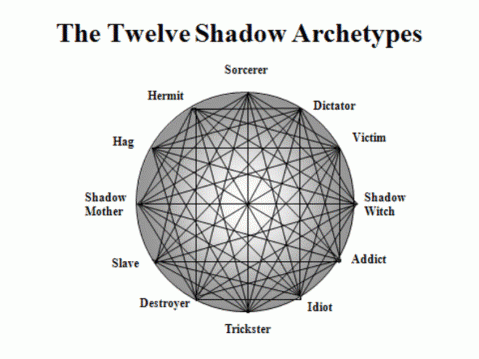
Jung identified these archetypes the Self, the Identity, the Darkness and the Anima/Animus. It hides our real self and Jung defines it as the "consistency" archetype.
The term originates from the Greek word for the masks that old stars made use of, signifying the functions we play in public. You can think about the Character as the 'public relationships depictive' of our ego, or the product packaging that provides our ego to the outside world. A well-adapted Identity can greatly contribute to our social success, as it mirrors our real personality characteristics and adapts to various social contexts.
An instance would be an educator who continually deals with every person as if they were their pupils, or somebody who is excessively authoritative outside their workplace. While this can be annoying for others, it's even more troublesome for the individual as it can cause an insufficient realization of their complete personality.
EMDR Therapy: A Breakthrough Treatment for EMDR therapy
This typically results in the Identity incorporating the much more socially acceptable traits, while the much less preferable ones come to be component of the Shadow, one more important part of Jung's character concept. An additional archetype is the anima/animus. The "anima/animus" is the mirror photo of our organic sex, that is, the unconscious womanly side in men and the masculine tendencies in ladies.
For instance, the phenomenon of "love at very first sight" can be described as a man projecting his Anima onto a lady (or vice versa), which causes an immediate and intense attraction. Jung acknowledged that supposed "manly" attributes (like autonomy, separateness, and aggressiveness) and "womanly" attributes (like nurturance, relatedness, and empathy) were not constrained to one gender or above the other.
Culturally Responsive EMDR therapy
In line with evolutionary theory, it may be that Jung's archetypes reflect tendencies that when had survival value. The Shadow isn't just negative; it offers depth and equilibrium to our personality, showing the principle that every facet of one's personality has a countervailing counterpart.
Overemphasis on the Identity, while ignoring the Shadow, can result in a superficial character, preoccupied with others' perceptions. Darkness aspects commonly manifest when we project disliked qualities onto others, acting as mirrors to our disowned aspects. Engaging with our Darkness can be difficult, however it's crucial for a well balanced personality.
Creating Emotional Resources During Trauma Processing
This interplay of the Character and the Shadow is often explored in literary works, such as in "Dr. Jekyll and Mr. Hyde", where characters come to grips with their dual natures, further showing the engaging nature of this aspect of Jung's concept. Finally, there is the self which supplies a sense of unity in experience.
That was definitely Jung's idea and in his publication "The Obscure Self" he suggested that most of the issues of contemporary life are brought on by "man's modern alienation from his natural foundation." One aspect of this is his sights on the importance of the anima and the bad blood. Jung argues that these archetypes are items of the cumulative experience of males and females cohabiting.
For Jung, the result was that the full emotional growth both sexes was undermined. Together with the prevailing patriarchal culture of Western people, this has brought about the decrease of feminine high qualities entirely, and the control of the personality (the mask) has elevated insincerity to a way of life which goes undoubted by millions in their everyday life.
Each of these cognitive features can be shared primarily in a shy or extroverted form. Allow's delve deeper:: This duality has to do with how people make choices.' Assuming' people choose based on logic and unbiased factors to consider, while 'Feeling' people choose based upon subjective and personal values.: This dichotomy issues just how people view or collect details.

Table of Contents
Latest Posts
Processing Defense Mechanisms with ADD/ADHD Testing & Evaluations
Integrated Trauma Therapy: A Detailed Technique to Recovery at Every Heart Dreams Therapy
Setting Progress Markers for Eating Disorder
Navigation
Latest Posts
Processing Defense Mechanisms with ADD/ADHD Testing & Evaluations
Integrated Trauma Therapy: A Detailed Technique to Recovery at Every Heart Dreams Therapy
Setting Progress Markers for Eating Disorder